

Greece appears to be acquiring an unexpectedly pivotal role in efforts to restart diplomacy between the United States and Iran, centered now not only on Tehran's nuclear program, but primarily on the Strait of Hormuz and the restoration of international maritime navigation.
This does not constitute, at least not yet, a formal Greek «mediation».
Washington indeed officially denies that Marco Rubio asked the Greek side to contact Iran or convey a specific American message.
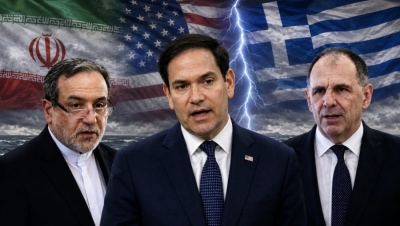
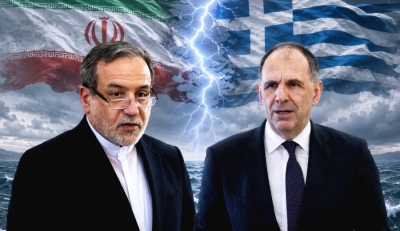
However, the sequence of events is difficult to ignore: on August 12, Rubio spoke with Giorgos Gerapetritis, with Iran and the Middle East among the discussion topics, and immediately the following day the Greek Foreign Minister contacted Abbas Araghchi.
The Associated Press reports that a European diplomat familiar with the contacts assesses that this chronological sequence was not coincidental.
The emerging picture is that, confronted with the stalemate of traditional channels through Oman, Pakistan, Qatar, and Turkey, American diplomacy is attempting to expand the network of interlocutors who can gain access to Tehran.
Greece and Austria have thus entered a new framework of informal European contacts: Austria due to Vienna, the International Atomic Energy Agency (IAEA), and its historical role in nuclear negotiations; Greece for an entirely different yet equally compelling reason, maritime shipping.
Why Greece...
Athens is not entering the fray because it represents a major naval military power in the Persian Gulf.
It enters primarily because it is the world's preeminent international maritime shipping power, and consequently one of the actors with the most to lose from a closed or restricted Hormuz.
The US may potentially anticipate a similar Greek posture in Europe to the one seen with Russian sanctions, where a veto was exercised because the Greek industry would suffer harm, an industry maintaining privileged ties with the government of Kyriakos Mitsotakis...
In 2026, the Greek-owned fleet accounts for approximately 19.1% of global carrying capacity in deadweight tonnage (DWT), numbering nearly 5,800 vessels, and even more critically for the Persian Gulf crisis, Greek shipowners control roughly 26% of global tanker capacity and 23% of LNG carriers.
These represent the exact vessel categories at the heart of the energy flows transiting Hormuz.
This confers two distinct profiles upon Athens simultaneously.
It is a close ally of Washington and a member of NATO, while concurrently representing a massive commercial and maritime interest requiring predictable, secure, and unimpeded transit.
For this reason, Greece can engage in dialogue with Tehran not merely as a Western capital, but as a nation whose vessels, shipping companies, and seafarers directly bear the brunt of the blockade.
Iranian control and «transit permits»: The new system...
This is precisely where the dilemma lies for Athens.
Iran has effectively established a regime in which passage is no longer treated as an automatic right of a merchant vessel.
A multi-layered system of Iranian screening has been documented, scrutinizing the ship's registered owner and operator, flag state, cargo, origin, destination, and even the nationalities of crew members.
Particular emphasis is placed on whether the vessel has any nexus to the United States or Israel, as Tehran has declared that ships linked to either nation may be barred from transit.
When passage is authorized, Iranian authorities may issue specific coordinates and safety instructions.
Reuters has documented instances of vessels provided with a specific corridor, accompanied by directives for strict adherence and continuous operational coordination with Iranian authorities.
Under certain bilateral arrangements, the process initiated with a formal request from a government to the Iranian Foreign Minister, subsequently referred to the Supreme National Security Council and military authorities.
Thus, the core of the protocol outlined across Iranian and regional sources is unmistakable: commercial status of the ship, verification of its affiliations (ensuring no ties to hostile states), compliance with a designated corridor, coordination with competent Iranian authorities, and abstention from maneuvers deemed threatening.
Final passage remains contingent upon Iranian authorization.
The newly established Iranian authority for Hormuz had already mandated that vessels submit advance requests, coordinating both transit routes and timing.
This is no longer a theoretical threat.
In May, Reuters reported that the Greek-interest vessel Agios Fanourios I transited via an Iran-designated lane, was halted by IRGC forces near Hormuz, and required renewed Iranian clearance to proceed.
The grand paradox for Greece
This creates a particularly arduous Greek dilemma.
On one hand, Athens officially advocates for freedom of navigation and maritime security. This was precisely the point emphasized by Giorgos Gerapetritis during his recent exchange with Abbas Araghchi.
On the other hand, operational realities on the water dictate that safe passage for Greek-owned vessels may require engagement with the very Iranian control mechanism that the West refuses to legitimize, and Greece, having taken an explicit stance, is viewed as inherently untrustworthy from the outset...
Herein lies the essence of American interest in the Greek diplomatic channel.
Greece possesses what Washington does not readily hold: an immediate, vast economic stake in restoring maritime commerce, coupled with the capacity for political communication with both parties.
Athens caught between Washington and Tehran
The situation grows further complicated because a vessel may theoretically comply with Tehran's prerequisites, yet its operating company could concurrently face exposure to American sanctions.
Washington has imposed sanctions on the Iranian entity attempting to regulate transit through Hormuz, while insurance markets have similarly warned of coverage issues should transit dues be paid to Iranian authorities.
Reuters characterized the dilemma confronting shipping firms as essentially a Catch-22: ensuring safe passage may necessitate compliance with Iranian directives, yet such compliance risks triggering sanctions or insurance invalidation in the West.
This is why the crisis in Hormuz is not merely military.
It is legal, insurable, commercial, and diplomatic.
Iran does not yield on the core issue
Tehran has been negotiating for weeks with Oman on a new maritime management framework.
On August 5, the Iranian Foreign Ministry announced that the two nations had already agreed on the geographic parameters of a proposed safe transit corridor, with technical, legal, environmental, and security dimensions under active review.
Iran clarified, however, that even an accord with Oman does not automatically imply that the Strait of Hormuz is open and safe as long as American military operations and the blockade persist.
Details regarding the framework under negotiation illustrate why the issue is so intractable: Tehran seeks a decisive mandate in regulating incoming maritime traffic into the Persian Gulf, whereas the American side and international maritime organizations insist on the principle of free, non-discriminatory transit.
This presents a fundamental clash with the position of the International Maritime Organization (IMO).
The IMO has maintained that the right of transit passage through international straits must not be impeded or suspended, that all vessels must be treated without discrimination, and that Hormuz has operated under an internationally recognized Traffic Separation Scheme since 1968, originally agreed upon by Iran and Oman.
This is the precise line Athens must navigate: engaging with Iran without conceding that the international right of transit passage is transformed into a discretionary privilege granted on a case-by-case basis by Tehran.
Past warnings and the stern message to Greece
The exceptionally harsh remarks by Abbas Araghchi regarding the interdiction of «hostile vessels», the mandate of Iranian military-security authorities, and the risks of «false flag» operations have left Greek Foreign Minister Giorgos Gerapetritis exposed.
At the time, the official Iranian Foreign Ministry noted that Tehran had enacted measures to block the transit of hostile ships and oversee the safe passage of others in coordination with competent military and security branches.
In their latest contact, this posture was compounded by a political assault against the European Union.
According to the Iranian side, the minister accused the EU of applying double standards regarding human rights, asserting that it lacks the «moral standing» to lecture other sovereign states.
The Greek side, for its part, maintained its commitment to diplomacy and maritime security, signaling a willingness to provide technical and specialized assistance.
Greece as an indispensable interlocutor, not a neutral mediator
The conclusion is that Greece is not abruptly morphing into a new Oman or a new Qatar.
It does not share the same level of mutual trust with Tehran and remains a close strategic partner of the United States and Israel.
Yet it commands a comparative advantage that is assuming immense importance at this juncture: Greece can speak on Hormuz not merely as a Western administration, but as the political seat of the world's most formidable commercial shipping fleet.
For Washington, this makes it a valuable conduit, even while recognizing its diminished credibility.
For Tehran, it represents an interlocutor with a tangible interest in reaching a viable working arrangement.
And for Athens itself, it presents an exceedingly challenging mission: assisting in restarting dialogue without letting the necessity of safeguarding Greek merchant shipping slip into tacit acceptance of a permanent Iranian control regime over Hormuz.
Because this is now the real stake: not merely whether the Strait will reopen, but under what terms it will open, who will determine which vessel passes, and whether the international right of free passage will endure as a right or degenerate into a permit granted on a case-by-case basis.
Greek maritime shipping is currently caught in this confrontation, and that is precisely why Greek diplomacy finds itself suddenly much closer to the center of US-Iran negotiations than anyone could have predicted just a few months ago.
www.bankingnews.gr




Σχόλια αναγνωστών